





1973 survey, priced today
$140 to $175 / weekCashBox's 20 games a day, charged at the $1.00 to $1.25 tables ship set at.

Buying an air hockey table looks like a simple decision until you see the price list. A six foot table for the family room costs about $800. A tournament grade eight footer costs $5,000. A commercial coin-op table with an LED playfield costs $10,000. They are all called air hockey tables, and they are not remotely the same product.
The differences boil down to the blower under the playfield, the material the surface is made of, the metal in the rails and the weight of the cabinet, and those four things decide whether the puck floats or crawls, whether bank shots come off true, and whether the table is still being played in five years.
This guide is written for two readers:
Most of the advice overlaps. Where it does not, the sections are signposted so you can skip to yours.
It covers the whole market: the entry level tables in the big box stores, the serious home tables, the commercial machines, and the brands behind all of them, whether we sell them or not. We stock Valley-Dynamo, ICE, Hathaway and Bandai Namco, and we say so where it matters, but this is the advice we would give a friend whichever table they buy.
Every figure comes from a manufacturer's own pages, a live catalogue or a live marketplace. Anything we could not verify has been left out.
In a hurry? Start with the six questions, read the three kinds of table, then jump to buying for your man cave or buying for your business.
Start here
Most people start by browsing tables. That is the fun part, and it is also the last step, not the first. Answer these six before you fall for a picture.

A full size table needs enough floor area once both players are standing at it, with about 3 feet of clearance on every side. section 7

From about $800 for a six foot home table to $10,000 for a commercial coin-op machine. section 2

A table for kids and guests can be six or seven feet with a modest blower. A table for players who slap the puck as hard as they can needs eight feet, real weight and a motor that never lets the puck sit down. section 5 / section 6

A home table is judged on how it feels. A location table is judged on uptime and earnings, which points to steel frames, industrial blowers and coin or card payment. section 2

Regulation is 8 feet by 4 feet, and it is the only size sanctioned for tournament play. Six and seven foot tables fit more rooms, and anything under five feet is a toy rather than the game. Combo and licensed tables are features rather than sizes, and come in these sizes too.

The blower motor is the part that fails, and it is the whole game when it does. Commercial brands sell every part for years. Cheap residential tables are often orphaned the day the line is discontinued. section 7
Know the landscape
Air hockey was invented in 1972 by a group of Brunswick engineers, and it went to bars and arcades first, not living rooms. That history still shapes the market: the game splits into commercial tables built to survive endless public play, home tables built to a price for family rooms, and a third group of combos, compacts and licensed tables that borrow from both. They cost different amounts, fail in different ways, and suit different people.
A home table is built down to a weight and a price. The cabinet is MDF rather than steel, the rails are usually plastic or aluminum rather than thick extrusion, the blower is smaller, and the scoring is electronic on the better tables and a manual slider on the cheaper ones. In exchange, it costs a tenth of a commercial machine.
Size is also a variable here. Typically the cheaper and home-based tables tend to have different size variants available. Commercial tables tend to be almost always full size. There are 6-ft, 7-ft, or 8-ft full sized home tables available.
The spread inside the category is wide. At one end are the $800 to $1,300 six footers from brands such as Hathaway, American Legend and Atomic: honest family tables that are fine for kids and casual games.
In the middle sit the $1,300 to $2,200 seven and seven and a half footers with stronger blowers and better rails.
At the top are tournament grade home tables, Valley-Dynamo's non coin models and Gold Standard Games' home line, which use the same construction as the commercial machines without the coin door, at $3,000 to $9,000.
The honest caveat with the cheap end: the blower. Budget tables often use small 12 volt DC fans pushing well under 100 CFM, and the airflow is uneven enough that the puck can slow or stop mid table. That is the single most common complaint with entry level air hockey, and it is why section 3 spends so long on the blower.
Durability differs too. A residential table played regularly tends to show its age in three to five years, where an arcade table is built to run for well over a decade. That does not make the home table a bad buy. It makes it a different product, and the price says so.
A commercial table is a different machine wearing the same name. The cabinet is heavy enough that leaning on it does nothing, the playfield is thick laminate or acrylic, the rails are solid aluminum, the blower is an AC industrial unit that runs all day, and the scoring is electronic with infrared sensors in the goals.
Weights run from about 340 lbs for Valley-Dynamo's compact Short Shot to 679 lbs for ICE's NHL Air FX with its overhead scoreboard.
They come in two flavors:
Coin-op tables have a coin door, a bill acceptor slot and often card reader support, and they are what you see in arcades and bowling alleys.
Free play commercial tables are the same build without the payment hardware, sold to serious home players and to venues that do not charge per game.
Most coin-op tables can also be switched to free play, so the same machine works in both worlds.
In our own range, commercial construction runs from $4,995 for a Valley-Dynamo Blue Streak to $9,995 for an ICE NHL Air FX coin-op, and the wider market is the same: roughly $2,700 to $10,000 depending on size, lighting and payment hardware.
Why pay three to five times the price of a home table? In concrete terms: a full size AC blower built to run all day against the small fan in a home unit, a playfield that will not warp or wear through, rails that bank a puck the same way in year ten as on day one, sensors instead of sliders, and a parts catalogue that still exists a decade later.
For a business all of that is the argument. For a home buyer it is a choice about how much you care that the game feels like the arcade.
Commercial tables are almost always full size, 7 ft or 8 ft, because a venue is selling the real game and a short table gives it away at a glance.
Around the two main camps sit four things worth knowing by name. None of them is a third kind of table. They are a size, a feature, a theme and a format, and each one can arrive on home or on commercial construction, at whatever price that construction costs.
How you spot it: A table tennis top or flip-over second game over the air hockey playfield.
The space saver's answer. Hathaway's Sherwood and Excalibur pair air hockey with table tennis. The compromise is that neither game is at its best.
How you spot it: A table short enough to sit on a desk, or a 20 to 55 lb frame a single person can move.
Real fun for kids, and a different game for adults: smaller pucks, lighter mallets, shorter rallies. Buy one as a toy, not as air hockey.
Arcade grade builds wrapped in a franchise, like Bandai Namco's Pac-Man table or ICE's NHL line. Great for family rooms and venues; not tournament equipment.
Built for family entertainment centers by Sega Amusements and others, sometimes with ticket redemption. Chaotic, social, and not sanctioned for competitive play.
One thing the novelty end of the market will not tell you: the sanctioning bodies draw a hard line here. Tables with flashing lights in the playfield, painted rails or undersized pucks are not approved for tournament play, however good they look in a dark room. If competitive play matters to you at all, read section 3.5 before falling in love with an LED playfield.
The price tiers below are where the market sat at a large US game room dealer in September 2026, as a snapshot of who plays at which level.
| Tier | Typical brands | Price range, September 2026 |
|---|---|---|
| Entry level home | Hathaway, American Legend, Atomic | $800 to $1,300 |
| Mid range home | Brunswick, Freetime Fun | $1,300 to $2,200 |
| Tournament grade home | Gold Standard Games, Valley-Dynamo | $3,000 to $9,300 |
| Commercial and coin-op | ICE, Valley-Dynamo, Kalkomat, Bandai Namco | $2,700 to $10,000 |
One more kind, and it gets a mention rather than a category of its own because it sits across the three above instead of beside them.
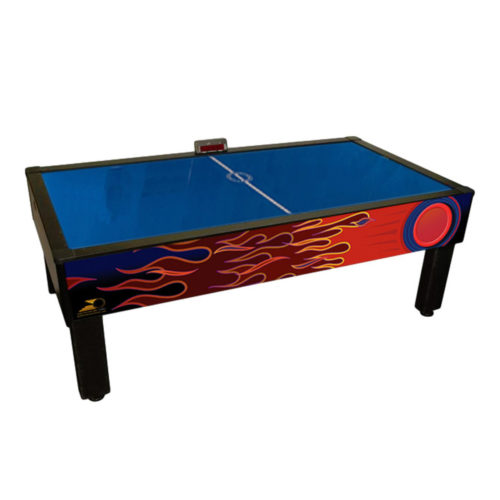
A custom table is a standard machine wearing your own artwork. The cabinet, the blower and the playfield are the stock build, and the graphics package is what changes. So whether it is a home table or a commercial one depends entirely on which model you start from, not on the fact that it is custom.
We carry three:
It suits a venue that wants the table to carry its own brand, and a home that wants something nobody else has. Because the machine underneath is unchanged, everything else in this guide still applies to it: the blower still decides how it plays, and the size still decides the room you need.
One practical difference: these are built to order rather than taken off a shelf. ICE quotes 2 to 6 weeks of production, and Valley-Dynamo about 6 to 8 weeks to delivery, so a custom table is not the choice if you need a table next week.
Artwork formats and proofing are a bigger subject than this section, and we handle them separately.
Two questions, in order. The first one is genuinely either/or. The second is where almost everyone actually spends their time.
Step one
Is anyone paying to play?
Which settles less than it sounds. A home table is anything from a $900 six footer to a $9,000 tournament machine, so this answer narrows the field rather than finishing the job. Go to step two.
A paying floor is buying uptime and earnings, not feel. A home table will not survive it, whatever it costs. Section 6 covers the rest of that decision.
Step two, if nobody is paying
Home tables span more than a factor of ten in price, so the tier decides far more than the label does. These are the three from 2.1, by who is going to play rather than by what you can spend.
Kids, guests and the occasional grudge match. A six footer, and the strongest blower you can get inside the budget. $800 to $1,300.
Adults who play often and hit hard. Seven or seven and a half feet, better rails, and a blower that keeps the puck moving end to end. $1,300 to $2,200.
Someone here has ambitions past the basement. Eight feet, commercial construction, no coin door. The whole sport in one purchase. $3,000 to $9,300.
One thing this does not decide: combo, compact, licensed and 4 player tables cut across all of it. Settle the construction and the tier first, then look for one that also folds out a table tennis top or wears a franchise.
The core analysis
Two tables can look identical from across the room and play completely differently. These are the things that separate a table you will love from one that ends up under a bedsheet in the garage.
The single most important spec on the table and the main point of failure. It decides whether the puck floats or drags, and it is covered in depth just below.
Wear resistant laminate or thick acrylic stays flat and fast for years. Thin coated MDF warps and wears, and a warped surface ruins the game.
Bank shots are half of air hockey, and the rails decide how they come off. Solid aluminum banks true; plastic deadens and chips.
Heavier is better. A table under 100 lbs walks across the floor during hard rallies. Commercial tables weigh 340 lbs and up for a reason.
Infrared electronic scoring keeps the game honest and the pace up. Manual sliders work, but somebody always forgets to move one.
Regulation pucks are 3-1/4 to 3-1/2 inch Lexan. Small tables use small pucks, and the game feels different the moment you pick one up.
All six are things you find out by playing. Which leads to the single most useful piece of advice in this guide, and the reason it sits here rather than at the end.
The float of the puck, the crack of a bank shot off a real rail, the way a rally builds speed: that is the product, and a $1500 table and a $5,000 table can look nearly identical while playing nothing alike.
So before you spend serious money, go and play the class of table you are considering. Any arcade, bowling alley or family entertainment center near you almost certainly runs a commercial table.
Air hockey only works because the puck is not touching the table. A motor under the playfield pushes air through hundreds of small holes, and the puck rides that cushion. When the airflow is strong and even, the puck glides end to end off one gentle hit. When it is weak or patchy, the puck scrapes, slows and dies in the dead zones, and the game underneath disappears.
What holds the puck up is pressure, not volume. The puck is a shallow dome with a rim, and it traps a cushion of air underneath exactly as a hovercraft does. The pressure needed is tiny, well under a hundredth of a pound per square inch, but it has to be there at every point on the table, including the far corner. That one fact explains everything else in this section, and it is why the number on the box is a poorer guide than it looks.
It is close to meaningless across makers, for the reasons below. Within one maker's range it is genuinely useful, because there it tells you which table is the bigger machine.
A centrifugal blower, the squirrel cage type, builds pressure. A small axial fan moves air without building much. That is the difference behind every "the puck dies halfway" review. If a listing will not say, a 110 V AC motor is a reasonable proxy and a 12 V one is a bad sign.
Because the motor and the playfield have to be engineered as a pair, what you are really buying is that somebody designed both together. Brands that assemble cabinets do not do that work. Brands that have made the game for decades do.
Two units distribute air more evenly down a seven or eight foot playfield than one central one. It is a design decision that shows the maker thought about the far corners.
One gentle push should carry the puck the full length. Judge the corners, not the middle: the middle is easy, and dead spots live in the corners and along the far rail. Buying online or used, ask for a video of a puck crossing the whole table.
It does not work. The airflow is a property of the whole table, not of the motor, and an oversized motor makes the puck harder to control rather than better.
The blower is what fails. On a commercial table it is a catalogue item, and often the failure is an $11 start capacitor rather than the motor. On an orphaned budget table a dead blower can be the end of the table.
Almost every guide online tells you to chase a higher CFM figure. Three separate lines of evidence say that advice is unsound.
The Physics
The blower fills the chambers under the playfield, and the holes meter the air out, so the hole count, diameter and spacing are as much of the answer as the motor is.
An engineer sizing one from scratch starts from the blower's pressure curve and designs the hole pattern to suit; the two only work as a matched pair.
Valley-Dynamo's service FAQ warns that "it is absolutely impossible to make a simple apples-to-apples comparison" and concludes that "more CFM is not immediately better, fewer CFM is not immediately worse, and upgrading a motor is probably not going to make any difference".
Their own figures prove the point: about 375 CFM in the full size Coin and Pro Style tables, about 85 in the compact Short Shot, and even the 85 far more than that playfield can process. Both are commercial machines, and a naive CFM rule would read the Short Shot as a budget one.
One last thing the spec sheet will never show: the airflow is only as good as the holes. A table with a strong motor and clogged or badly drilled holes still plays dead, which is why clearing the playfield holes is the first item in every maintenance schedule, and why a tired table is worth cleaning before it is worth diagnosing.
Surface. Wear resistant laminate or thick acrylic stays flat for years. Thin painted MDF warps, and a warped playfield is unfixable.
Rails. Solid aluminum returns a bank shot true; plastic absorbs it. Bank shots are half the game, so this matters more than any styling.
The seam. Run a fingernail where the rail meets the surface. A lip over about three hundredths of an inch will wedge or kick a fast puck. On a used table, look for chipped laminate along that line.
LED playfields look spectacular and pull players in a venue, but they are not approved for tournament play. Pick one job or the other.
Scoring. Manual sliders never break. Electronic side scoring keeps the pace up. Overhead scoring reads across a room but adds roughly 40 inches of height, so measure the ceiling first, and it rules the table out of tournament play.
Pucks. Regulation is a 3-1/4 to 3-1/2 inch polycarbonate disc. Small tables ship small, light pucks that lose the heavy glide of the real game.
Mallets. High tops suit beginners, flat tops give more control. Tournament rules cap them at 6 ounces and just over 4 inches.
Buy spares on day one. Pucks vanish under furniture at a remarkable rate.
The US Air-Hockey Association sanctions the tables tournaments are played on, and the list is a useful quality signal even if you never play a match.
Only 8 foot tables qualify, from three makers: every Gold Standard Games 8 footer, several Valley-Dynamo 8 footers, and a single Brunswick, the original Blue Top. Flashing playfield lights, painted rails, undersized pucks and overhead light bars all disqualify a table, which is why Dynamo's own Hot Flash 2 is absent. No multiplayer table is sanctioned.
What it buys is repeatability: the same float, banks and puck wherever you meet one. It also explains a maintenance quirk, since Dynamo advises against scrubbing the rails because a worn in rail banks more accurately.
One caveat. The published list was last dated 2017, so confirm the exact model with the association or the maker before ordering.
Who makes them
Air hockey is a small industry with a clear pecking order. Two American companies dominate the commercial game, one of them owns the tournament scene, a handful of arcade and specialist makers serve venues on both sides of the Atlantic, and a crowd of house brands fills the big box stores. This section profiles the makers that matter and scores them on four criteria. Every one of them can be bought in the United States. We stock four of them, and we say which.
Every maker gets a score out of ten on four criteria, averaged into one rating, the same way we score the makers in our pinball buying guide. The scores are our opinion, formed from published specifications, warranty terms, dealer coverage and prices. We are an online retailer, so the playing criterion is judged from construction rather than from having played every table. Nor are the scores built on customer reviews: four of these makers sell only to venues through distributors and have no owner reviews at all, so scoring on reviews would judge the brands on different evidence and make the numbers uncomparable. Where a brand does have real review volume we name the figure and the retailer on its card. They are not a ranking of which table you should buy. They are a quick read on the company behind it.
Cabinet, surface and rail construction, how the table arrives, how it holds up under play, and how easy it is to service.
Judged from construction rather than from play, because we sell online and cannot put a puck on every table: blower type, rail material, playfield material, and whether the model is sanctioned. Those four predict how a table plays more reliably than any spec on the box.
The length and coverage of the warranty, the dealer network, and whether parts and manuals will still be available in ten years.
What you get for the price at each tier, how the price compares with the rest of the market, and how well the table holds its value.
In rough order of weight in the market. Prices are our own or the maker's published prices unless we say otherwise.


Valley-Dynamo is the name most people mean when they say commercial air hockey. Its tables carried the tournament scene through the 1980s and 1990s, and the modern line keeps the same recipe: the Dyna-Blast blower, impact resistant Formica playfields, uncoated aluminum rails for fast, true banks, and common components shared across the range so an operator stocks fewer parts.
The lineup logic is simple. Blue Streak is the 7 footer for rooms where 8 feet will not go, Best Shot is the full size coin-op, Pro Style is the same toughness without coin operation and with a USAA approval, and Hot Flash II and Fire Storm are the flagship 8 footers with overhead LED scoring, the Fire Storm redesigned with the home market in mind.
Honest caveats
Our comment: The default answer for a venue and the safe answer for a serious home. You are buying the industry's reference table and a parts shelf that will outlive the fashion.

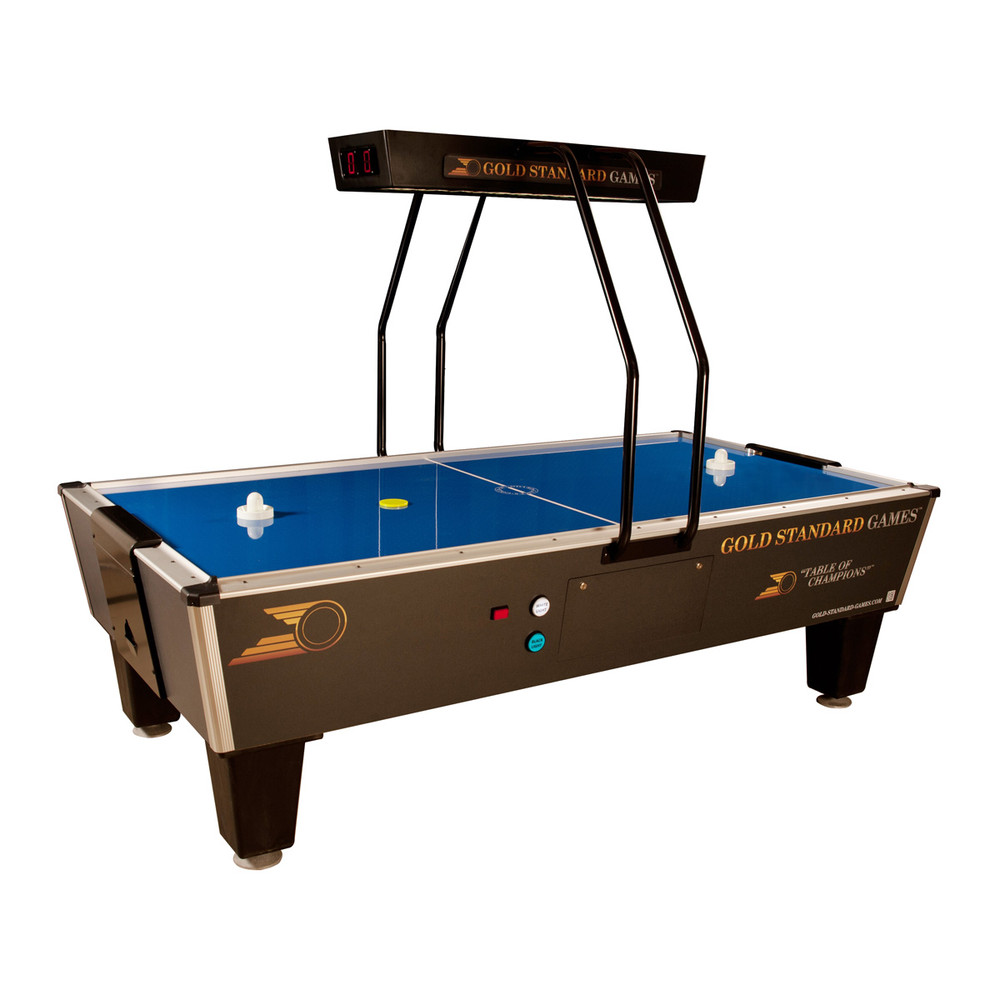
Gold Standard Games is what happens when a two time world champion buys a factory. Mark Robbins helped develop Dynamo's great tournament tables in the 1980s and 1990s, then bought Michigan's Shelti plant and set out to build the best playing table on the market. The tournament scene largely agrees that he did. Notably the company publishes no airflow figure for any of its tables, describing the Tournament Pro only as having a "Commercial Blower for Championship-Level Air Flow", and lets the sanctioning speak instead.
These are purist's tables: wear resistant laminate, low profile aluminum rails, a full size 3-1/4 inch puck on the 7 footer and 3-1/2 on the 8, and no LED theater anywhere. The Home Pro Elite is the rare home table that plays like the arcade.
Honest caveats
Our comment: The tournament player's brand, designed by the best player of his era. If pure play quality is the whole brief, this is the benchmark the others are measured against.


ICE is the showman of the industry. Its half inch acrylic playfield, which it bills as the thickest in the business, is lit from below by programmable LEDs, the lighting runs through the rails and legs, and the whole table glows like something out of Tron. It is also the only maker with an official NHL license, with team playfields, an NHL style scoreboard and horn.
The Air FX Pro brings that build home: the same powder coated steel frame and commercial blower in a free play, 8 foot regulation table with a quieter phenolic bumper system, shipped mostly assembled. And because every table is built to order in Buffalo, custom playfield artwork is a real option, not a special favor.
Honest caveats
Our comment: The table that draws the crowd. For a venue the brightest thing on the floor earns its keep, and for a home buyer who wants the full arcade spectacle there is nothing else like it.


SAM is the European answer to Valley-Dynamo, and the maker most likely to be missing from an American buying guide despite building at the same level. Its flagship Fast Track 220 EVO 2 is a full size commercial table at 220 kg, running the company's own SAM9 control board, which reads seven different match events and drives the LED lighting and sound from them. Construction is plywood and aluminum with purpose designed rebound rails and a polycarbonate playfield.
What SAM does that nobody in the American market does is vary the shape of the game. The Slalom EVO 2 plays on a curved playfield, the Double EVO puts four players on one table, and the children's range goes right down to a licensed Hello Kitty cabinet. For an operator building a floor that does not look like every other floor, that catalogue is the appeal.
Honest caveats
Our comment: A genuine commercial heavyweight that most American buyers never meet. If you are reading this in Europe it belongs on your shortlist beside Dynamo and ICE; if you are in the United States, admire the catalogue and check what your distributor can actually support.

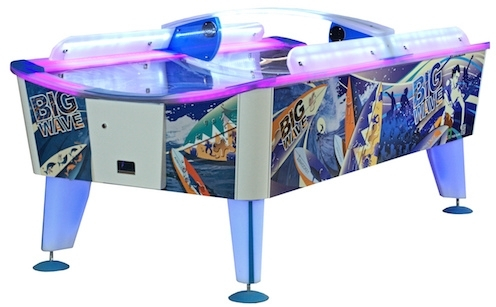
WIK is the manufacturer nobody in the American market competes with on one specific thing: its tables go outside. The Storm and the Big Wave are fully waterproof and rated for year round outdoor use with no cover, built on a perforated polycarbonate playfield with polycarbonate barriers and framing rather than laminate over wood. If you run a terrace, a pier, a campsite or a seasonal venue, this is close to the only serious answer on the market.
The second distinctive thing is the shape. Both outdoor models use a deliberately convex playfield rather than a flat one, which changes how the puck comes off the rails and gives the game a feel no flat table reproduces. Elsewhere in the range the tables are conventional: the Skate, Matrix and Shark are flat commercial coin-op machines, and the Kickshot is a 6 footer for tighter rooms.
Honest caveats
Our comment: The outdoor specialist, and the only maker here that publishes a warranty longer than a year. If your table is going anywhere weather can reach it, WIK is the shortlist rather than an item on it.


The commercial builder that undercuts the big two. The cabinets are 3/4" cabinet grade plywood, the beds are Formica with a wear guard finish, the blowers are industrial rated, and a full size table weighs 400 lbs. That is genuine location equipment at a price closer to a tournament home table than to an arcade machine.
The reason to know the name, though, is the Boom-A-Rang. It is a wedge shaped corner table with the two players side by side rather than opposite each other, and it occupies about five square feet against a wall. Nobody else builds a serious answer for a room that will not take a rectangle.
Honest caveats
Our comment: Commercial construction at a price that undercuts the big two, and the only maker with a real answer for an awkward corner.

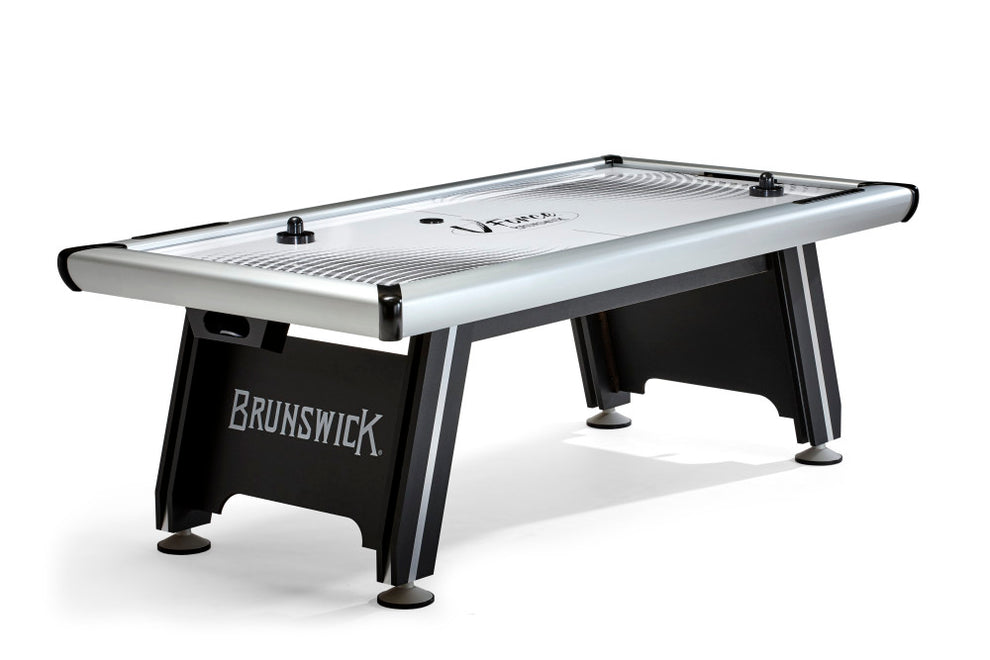
Brunswick is the founding name of the sport, and its early commercial tables are still the stuff of tournament legend. What you buy today is the badge rather than the company: Brunswick Billiards passed out of Brunswick Corporation and through Life Fitness before Escalade bought it in 2022, and the V-Force 2.0 and Windchill are handsome, furniture grade home tables aimed at the mid range of the market rather than the arcade.
Honest caveats
Our comment: The heritage pick for a mid range home table that has to look good in a finished room. Buy it for the cabinet and the name; buy elsewhere for tournament air.


Hathaway is the family room specialist, and the one maker here with real review volume: 4.4 out of 5 from 593 Wayfair reviews on its best rated model. Its tables are 6 to 7.5 feet, electronic scoring on the better models, wood cabinets that look at home next to real furniture, and prices that start under a thousand dollars. The combo models, the Sherwood and Excalibur with table tennis tops and the Driftwood set, are the brand's signature move: two or three games in the footprint of one.
Honest caveats
Our comment: The honest budget answer. For kids, families and casual games it delivers exactly what it promises at a price nothing commercial can touch.


Bandai Namco's tables are arcade machines first and sports equipment second. The Pac-Man and DC tables are built to commercial weight with acrylic playfields, themed light and sound packages, and artwork that does half the selling. In a family entertainment center they earn like the licensed pieces they are, and in a themed game room nothing else says arcade as loudly.
Honest caveats
Our comment: The theme pick. Buy it because the room, the kids or the customers love Pac-Man or the DC universe; the arcade grade build underneath is the bonus.

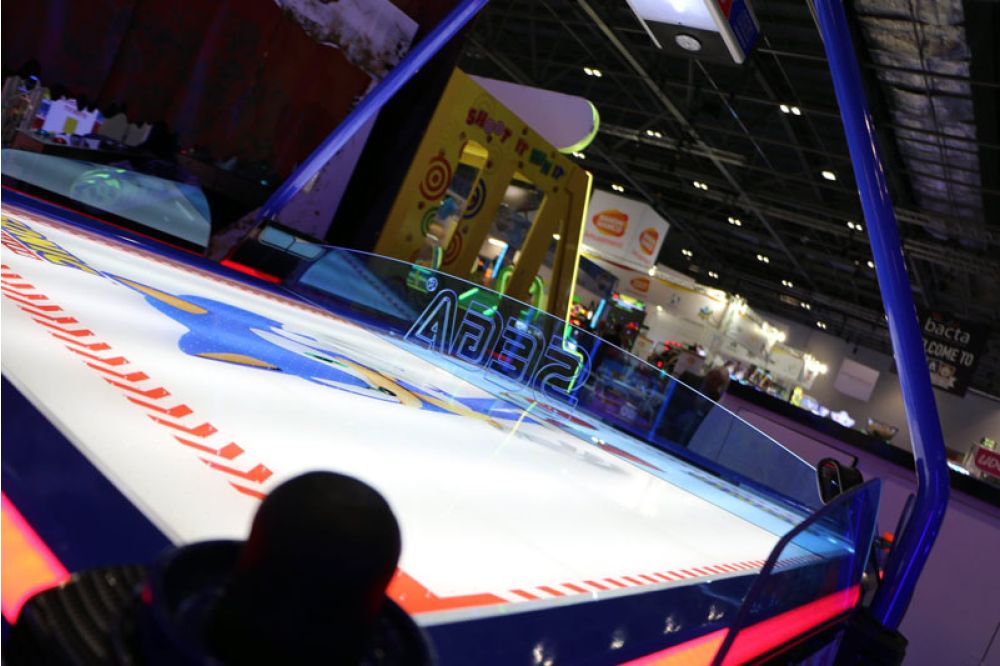
Sega's air hockey line wears Sonic the Hedgehog the way its arcades always have: reactive LED lighting, themed audio, scratch resistant playfields and ticket options, in 2 player, 4 player and toddler sizes. It is pure arcade equipment, designed to be recognized from across a busy floor and fed all day.
Honest caveats
Our comment: The franchise table for arcades, with the most recognizable mascot in gaming doing the marketing. A venue buy, not a home one.
Below the specialist market sits a crowd of house and retail brands. None of them builds a tournament table, and none of them pretends to. They matter because they are where most first tables come from, and because the differences between them are smaller than the differences between any of them and the brands above.
Escalade Sports' game room brand, and the most spec forward of the retail names: 120 V blowers across the range, LED light shows on the Top Shelf and Vibe, and an 8 footer in the AH800.
Tables to look for: Blazer 7 ft, Top Shelf 90 inch, AH800 8 ft
The volume champion of the sporting goods aisle, sold under the Medal Sports corporate name and including ESPN branded tables. Strong value at the small end; treat the published sizes as toy sizes, not sport sizes.
Tables to look for: The 7.5 ft models with electronic scoring
GLD Products' brand, best known for 3 in 1 flip tables that stack air hockey with billiards and table tennis. The right answer when the room has one footprint and three ambitions.
Tables to look for: Original 3 in 1, 7 ft air hockey models
A stablemate of Hathaway's tier: 6 and 7 foot family tables in the $800 to $1,300 band, sold through the same dealer channels.
Tables to look for: Kirkwood 84 inch
Budget tables and novelty formats, including small combo and LED models. Fine as a toy for younger kids; not a table an adult will play seriously.
Tables to look for: The 7 ft Fire 'n Ice if the LED look is the point
Three things to hold onto at this end of the market. First, reviewers who cover residential air hockey agree there is no clear leader among these brands the way Dynamo and Gold Standard lead the serious market, so compare the individual table, above all its blower, rather than the badge. Second, parts: a commercial table can usually be repaired decades on, while a discontinued retail table often cannot, which is worth remembering when a used one looks cheap.
Third, the choice on the shelf is narrower than it looks. Atomic, American Legend and Triumph are all Escalade brands, and so is Brunswick since 2022, which means four of the names above answer to one parent. Comparing them is often comparing price points inside a single catalogue rather than comparing companies.
The scored makers in one list, in score order. The big box brands are left out because they are not competing in the same game.
Range: $4,995 to $9,295 with us, home and coin-op
Warranty: 1 year table, 90 days parts
Best for: Venues, and serious homes that want the arcade standard
Range: From about $4,900 at dealers
Warranty: 1 year limited, published by the maker
Best for: Tournament play and purists
Range: $7,195 to $9,995 with us
Warranty: 1 year
Best for: Venues that want the showpiece, NHL fans, custom builds
Range: Not published; through Betson in the US
Warranty: 24 months consumer, 12 months business
Best for: Outdoor and weather exposed sites, and curved playfield novelty
Range: About $3,300 to $5,000 through dealers
Warranty: 12 months parts, 5 years on the wood
Best for: Venues wanting commercial build for less, and awkward corners
Range: Not published; through distributors
Warranty: Not published
Best for: European venues, and any floor wanting curved or 4 player tables
Range: Through distributors
Warranty: 90 days on commercial products
Best for: Arcades that want the Sonic license
Range: $5,999 to $6,795 with us
Warranty: 90 days on defective parts
Best for: Themed rooms and licensed appeal
Range: From $1,525 at list
Warranty: 90 days to lifetime by part
Best for: Mid range home buyers who value the cabinet and the name
Range: $815 to $1,935 with us
Warranty: 6 months
Best for: Families, first tables and combo rooms
The four we carry cover the four jobs most buyers actually have: Valley-Dynamo for the serious game, ICE for the spectacle, Hathaway for the family budget, and Bandai Namco for the theme. Where another brand fits your job better, the profiles above say so.
Reader path one
A home table has one job: still being played in year five. Room, delivery, assembly and running costs sit in section 7, because they apply just as much to a business buyer.
Any table in our range earns its place, but these three are the ones we would point a new buyer toward, one from each tier.

The most table Hathaway makes: 7.5 feet, electronic scoring and a proper wood cabinet, at a price the whole family can justify.
Dynamo's commercial construction without the coin door, approved for tournament play. The table serious players tell each other to buy.
The commercial Air FX build in a free play home edition, backlit acrylic and all, with your team on the ice. The room's centerpiece from the day it arrives.
If the budget stretches: the Fire Storm is Dynamo's flagship redesigned with the home market in mind, overhead LED scoring included, and the Hot Flash II is the modern version of the best selling table in the game's history.
If space is the constraint, Dynamo's Short Shot puts full commercial construction into 65 inches, and a combo table covers two games in one footprint.
Reader path two
An air hockey table on location is a small business inside your business, and it should be judged like one. Space, delivery and running costs are in section 7.
The only public survey of air hockey earnings is fifty years old.
In 1973 CashBox asked operators what each kind of machine took in a week. Hockey tables came in at $35, ahead of pool tables and pinball. Air hockey was new and booming then, so read that as a good year.
The useful part is not the money. It is the traffic. At the quarter a play coin-op charged then, $35 a week is 140 games, about 20 a day.
Do not simply run that through the CPI, because play prices have not kept up with inflation.
A 1973 quarter is $1.88 today. Yet commercial tables still ship factory set at $1.00 a play, adjustable to $1.25. In real terms, a game costs about half what it did.
So price the 1973 traffic at today's rates. Twenty games a day is $140 to $175 a week, not the $263 the CPI alone would hand you. Card reader floors charge more, $1.50 to $2 a game.
But two parties with money at stake do publish figures. Crestmont Capital, which finances these tables, says "$50 to $300+ per week depending on foot traffic". JVL, a machine maker since 1984, counts in days. It puts a typical spot at "$5 to $30 per day", which is $35 to $210 a week.
Its top performers take "$50 to $100+ per day", or $350 to $700 a week. That is busy bars and family entertainment centers, well above an ordinary floor.
CashBox's 20 games a day, charged at the $1.00 to $1.25 tables ship set at.
What a finance company underwrites a coin or card reader table at.
The manufacturer's $5 to $30 a day, in an ordinary commercial spot.
Busy bars and family entertainment centers only, and above our band.
All four ranges on one scale, zero to $700 a week. The overlap is the band.
Three sources, three methods, one answer.
Reckon on $50 to $300 a week, roughly $200 to $1,300 a month. Treat $140 to $175 as the likeliest spot for ordinary trade. Most tables sit in the lower half, and only a busy floor beats the top.
In games rather than dollars: about 7 to 43 plays a day at a dollar a play, or 4 to 21 at two. That is the number to hold against your own room.
The trade agrees, without ever naming a figure. Valley-Dynamo sells the Cosmic Thunder to "any location wanting to earn serious revenue". Dealers promise "an average play based ROI within the first year".
That last one you can test. A $5,000 table paid off in twelve months needs about $100 a week, which sits inside the band and a little under the middle. The claim and the arithmetic agree.
So pick the column your floor can hold, read across from the price, and you have the month the table stops being an expense.
One cost a foosball table does not have: the blower runs all day, so a little of the cash box goes back out as electricity.
4 to 12 months
at $100 to $300 a week
8 to 24 months
at $100 to $300 a week
About $19 / month
350 W for twelve hours a day, which a foosball table does not draw
Cells are shaded by payback speed. Greener is faster.
This is a reasoned assumption, not reported earnings. Nobody surveys what these tables take. The columns are simply the $50 to $300 band above. The cells are arithmetic: price divided by monthly takings, less about $19 a month for power (350 W, twelve hours a day, at the EIA's 14.53 cents per kWh). It tells you what a weekly take would mean. It does not tell you which column is yours.
Then work it out for your own floor, because a band is not a forecast.
Price per play, times plays per day, times days open. Price you read off the coin door. Plays per day only you can estimate, from your own traffic at the hours the table would be busy. The rest of the pitch is decoration.
What makes it work at all is that the machine needs no staff. It collects, resets and starts the next game by itself. The labor is a nightly wipe and a check of the coin box, and almost the whole cash box is margin.
You can also find out before spending anything. Place a table through an operator: they own it, they service it, and you split the cash box.
You earn less per game. In exchange you learn what your floor actually produces, from your own takings rather than somebody's brochure. If the numbers come in, buy your own.
The coin box is often the smaller half of the return. Air hockey is the most approachable machine on any floor: no rules to learn, no skill barrier to a first game, over in five minutes, and loud in the way that makes other people watch. A parent who would never touch a fighting game will play their kid at air hockey, and then buy the drinks and the pizza that never show up in the coin count.
That breadth is air hockey's edge over almost everything else you could put in the same footprint. A pinball machine draws its devotees; an air hockey table draws everybody, from date nights to birthday parties. Venues that track dwell time consistently find the game tables stretch visits, and a table visible from the entrance is an argument for coming in at all.
Location play is brutal in a specific way: it is not malice, it is volume. Hundreds of games a week, mallets slammed flat, children hanging off the rails, drinks on the cabinet. The equipment answer is the commercial tier and nothing below it, because a residential table on a public floor is measured in months.
What to insist on: a steel or heavy commercial cabinet, an industrial AC blower rated for continuous duty, thick laminate or acrylic on the playfield, solid aluminum rails, infrared scoring with jam proof sensors, and leg levelers that one person can adjust. Dynamo's coin-op line and ICE's Air FX are the reference points, and both makers sell every wear part separately, which is what uptime actually depends on in year six.
Then choose the flavor for your floor. A sports bar gets more from an NHL table with the horn; a family entertainment center gets more from a 4 player table or a ticket dispensing model; a barcade aiming at league players wants the plain sanctioned table the purists respect. The build underneath should be commercial in every case.
Payment. Modern commercial tables ship bill acceptor ready with dual coin mechanisms, and ICE supports coin, card and ticket dispensers installed at setup. Fewer people carry quarters every year, so on a busy floor a card or contactless reader pays for itself quickly. Most coin-op tables also switch to free play, useful for parties and league nights.
Placement. Visible from the entrance or the bar, with a full 3 feet clear at each end for the players and room for spectators without blocking a walkway. Away from anywhere a drink lands on the playfield. An air hockey table in play is its own advertisement, so do not hide it; do put it where its noise belongs.
Routine. Daily: wipe the playfield with a dry cloth. Weekly: clear the air holes and check the blower intake for dust. Monthly: confirm even airflow end to end, tighten fasteners, calibrate the scoring. Quarterly: inspect the cord, plug and scoreboard. Yearly: assess the blower bearings. The whole schedule is minutes, and it is the difference between a table that earns for a decade and one that dies at three years.
Paperwork. Check whether your city or state requires an amusement device license for coin operation, and confirm with your insurer that the machine is covered. Both are cheap to sort in advance and expensive to discover late.
Home or business
Everything up to here has been about choosing. This part is about owning: how much room the table needs, what delivery day looks like, how it goes together, and what it costs to run. It reads the same for a basement or a bar floor.
The table is only part of the answer, because a player stands at each end and both of them lunge. For a full size table, plan a floor area of about 14 by 10 feet minimum, and 15 by 12 feet if you want the game to breathe, which comes down to roughly 3 feet of clearance on every side of an 8 by 4 foot table. Smaller tables scale down: a 7 footer is comfortable in about 10 by 7 feet of dedicated space, a mid size table in 8 by 6, a kids' table in 5 by 4.

Height is the easy part: tables run 30 to 37 inches tall, so any ceiling works, until you add an overhead scoring gantry. Dynamo's overhead models stand 71 inches and ICE's NHL Air FX 62 inches, so check light fixtures and low basement ceilings against the gantry, not the table.
Three practical checks before ordering. Tape the footprint on the floor with painter's tape, including the clearance, and live with it for a day. Measure the route in: the doorways, the stairs, the turns, against the shipping carton rather than the assembled table, because a full size table ships in a box up to about 103 inches long. Check the floor: full size tables weigh 100 to 250 lbs at home grade and 340 to 680 lbs commercial, standing on four to six legs, and the table must sit level to play right. Do not push it into a corner; both ends need a player.
Power is a standard 120 V outlet for home tables. Commercial tables draw 250 to 450 watts, ICE publishes 110 V at 7 amps, and a dedicated circuit with a surge protector is the professional habit: the blower runs for hours at a stretch, and the scoreboard electronics are the expensive thing a power spike finds first.
A full size table arrives by freight on a pallet, and the boxed weights are what people underestimate: a Hathaway Brentwood ships at 359 lbs boxed, a Dynamo Hot Flash II at 485 lbs, an ICE commercial table at up to 700. ICE ships on a pallet around 90 by 30 by 68 inches. Here is how the day goes when it goes well.
Move furniture, prop doors, and lay cardboard on any floor you care about. Standard freight is curbside: getting the pallet from the curb to the room is your side of the deal, so have two strong adults and a hand truck, or book white glove delivery where it is offered.
Photograph every side, and note any damage on the delivery paperwork before the driver leaves. Freight claims are far easier with that note.
Get the boxed table where it will live before you open it. Assembled, a full size table barely fits through anything, and commercial tables ship mostly built.
One ordering caveat worth knowing across the industry: custom built tables, which includes Dynamo, Gold Standard and most coin-op orders, generally cannot be canceled once production starts, and built to order lead times run from 2 to 6 weeks. Order early and do not order a custom table against a fixed deadline.
Air hockey is one of the easiest big game room purchases to assemble, and the more you spend, the less you do. Commercial tables arrive as an assembled body: you fit the legs, mount the scoring unit or gantry, level it and plug it in. Home tables arrive flatter and take an evening. Either way, plan on two adults, because every step involves lifting something long and awkward.
Open the carton flat on the floor and check every bagged part against the manual before anything else. Claims for missing hardware are easiest on day one.
With the table body face down on the carton padding, bolt on the legs and levelers, then turn the table upright with one adult per end. This is the heavy moment; do not improvise it alone.
Side scoring units screw to the rail or cabinet; an overhead gantry bolts to the ends and its display cable connects underneath. Follow the manual's order so the wiring lands where the connectors are.
Put a bubble level on the playfield in both directions and adjust the leg levelers until it reads true. An unlevel table drifts every slow puck toward one goal and spoils the game in ways nobody diagnoses later.
Plug in, switch on the blower, and set a puck at each end and in the middle. It should float freely everywhere. If it drags in one zone, check for packing dust in the holes and vacuum the blower intake.
Assembly manuals for every table we sell are linked on the product pages. Read yours the night before the freight arrives; fifteen minutes of reading saves an hour of guessing.
Air hockey is the cheapest big game room machine to own. There are no coils, ramps or motors beyond the blower, nothing needs software, and the consumables are pucks and mallets at a few dollars each. What the table asks for instead is small and regular.
Routine upkeep. Wipe the playfield with a soft dry cloth, never household cleaners or anything wet, because liquids find the air holes and the blower below. Clear the holes when they clog, a vacuum pass or a toothpick for stubborn ones, and keep the blower vents free of dust. On commercial tables, calibrate the scoring monthly. At home the whole regime is minutes a month.
One counterintuitive rule from Dynamo: do not scrub the rails. Worn in rails bank more accurately than fresh ones, which is why tournament rules expect a played in table. Clean the surface, leave the rails their patina.
The occasional repair. Over the years the parts that fail are the blower, a goal sensor and the scoreboard, roughly in that order of consequence. On a commercial table each is a stocked part and an afternoon. This is where the brand choice pays off or does not: with older residential tables from discontinued lines, parts are often simply unavailable, and the table's life ends with its blower.
Warranty realities. Coverage is shorter than the prices suggest: ICE gives 1 year, Valley-Dynamo 1 year on the table and 90 days on parts, Hathaway 6 months, and warranties cover defects, not wear. Register the table when it arrives and keep the paperwork with the manual.
Making the purchase
Where you buy depends on the tier, and each channel has its own rules.
New, from a specialist dealer. The serious brands, Dynamo, Gold Standard, ICE and the arcade makers, sell through dealers and distributors, and the right dealer matters more than the last hundred dollars: one that ships freight properly, quotes honest lead times on built to order tables, and answers the phone after the sale. Every table in our air hockey collection lists its dimensions, weight and warranty, and we will tell you before you order whether a table is in stock or in a build queue.
New, from a general retailer. The entry level brands live in sporting goods stores and online marketplaces. The channel is fine; just carry the section 3 checklist with you, because at this end the spec sheet is the product and the blower line is the one that matters.
Used and refurbished commercial. The sleeper option. Operators rotate machines out of venues, and a certified refurbished Dynamo or ICE from a distributor costs home table money for commercial construction, with parts still available for everything on it. A used residential table is the opposite bet: cheap, but one blower failure from the landfill.
Custom and built to order. Dynamo, Gold Standard, ICE customs and most coin-op configurations are built when ordered. Expect a lead time of weeks, a no cancellation policy once production starts, and freight delivery. Plan the room and the route in before you commit, not after.
Red flags on any route. A listing that never names the blower, a commercial price on a residential build, a seller who will not run the table for you, full payment demanded months before a build ships, and photographs that never show the playfield straight on.
Quick answers
Reference
Air hockey has its own vocabulary, and most of it is doing real work rather than showing off. These are the terms used above, in plain English.
The right air hockey table fits the room with 3 feet to spare on every side, fits the budget with delivery included, and matches who is actually going to play it. Decide the tier first: a home table if the job is family fun, tournament grade if the adults are playing for real, commercial if the table is going to work for a living. Then judge any candidate by the four things that decide the game: the blower, the surface, the rails and the weight.
For a man cave that usually means the strongest blower and biggest table the room and budget carry, because nobody has ever complained that the puck floats too well. For a venue it means commercial construction, a payment system your customers actually carry, and a spot on the floor where the table can do its own marketing.
Whichever path you are on, we are happy to talk it through, including the brands we do not sell. Start with the Valley-Dynamo, ICE and Hathaway collections, or browse every air hockey table we carry in one place.
Enjoyed this read? There's more where that came from. Get exclusive content, insider tips, and special offers delivered straight to your inbox. Sign up for our newsletter here.
Happy air hockey gaming!
If you enjoyed this blog, please consider sharing it across social media.
Feel free to drop a comment below if you have any other questions or if you're interested in exploring another topic.
Leave a comment